I remember a Saturday night back when I was managing a high-volume catering kitchen, trying to pull forty trays of roasted vegetables out for a wedding. I had the dials set perfectly, but the pans came out looking like they’d been sitting in a lukewarm bath rather than a searing oven. That’s when I realized that trusting your appliance’s built-in display is a fool’s errand; oven temperature accuracy is rarely something you can take on faith. You can buy the most expensive, stainless steel professional range on the market, but if that heating element is lying to you, your expensive ingredients are just going to waste.
I’m not here to sell you some high-tech, Wi-Fi-enabled gadget that promises to revolutionize your life. Instead, I’m going to show you how to stop playing guessing games with your dinner. I’ll walk you through the simple, low-cost ways to verify your heat and ensure your kitchen actually works the way it’s supposed to. We’re going to cut through the marketing fluff and get back to the basics of reliable cooking, because a kitchen is only as good as the tools you can actually trust.
Mastering Oven Thermometer Usage for Real Results
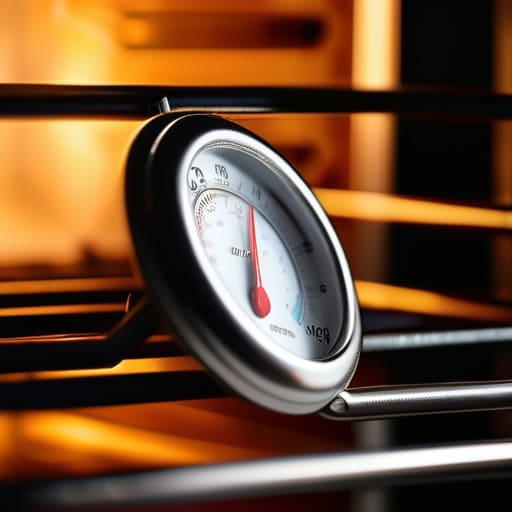
If you’re still relying solely on the little dial on your stove, you’re playing a guessing game you’re destined to lose. I’ve seen too many expensive cuts of meat ruined because a recipe called for 375°F, but the oven was actually hovering at 350°F. To fix this, you need a standalone analog thermometer. Proper oven thermometer usage isn’t about being obsessive; it’s about being precise. Place it right in the center of the rack to get a true reading of the ambient heat. If you notice the temperature swings wildly every time the heating element kicks in, you’re dealing with poor thermal distribution in ovens, and no amount of recipe tweaking will save your soufflé.
Once you have your thermometer, don’t just look at the number and walk away. Use it to start identifying oven hot spots by moving the device to different corners of the cavity. If the back left is consistently ten degrees hotter than the front, you’ll know exactly when it’s time to rotate your pans halfway through. This is how you achieve true baking temperature consistency without the frustration.
Solving the Mystery of Convection Oven Temperature Variance
If you’ve ever pulled a tray of cookies out only to find the edges are charred while the centers are still raw dough, you’ve run head-first into convection oven temperature variance. In my years managing catering kitchens, I learned that a convection fan isn’t just a luxury; it’s a powerful tool that changes how heat moves. Because that fan forces hot air to circulate, it often makes the oven feel hotter than the dial suggests. If you aren’t adjusting your settings, you’re essentially fighting your own equipment.
The real headache, though, is dealing with uneven thermal distribution in ovens. Even with a fan, you’ll often find certain corners are significantly hotter than others. To fix this, I recommend a simple test: place several small, identical items—like metal ramekins or even just a few pieces of parchment—across different parts of the rack. This is the most practical way of identifying oven hot spots without wasting expensive ingredients. Once you know where those rogue heat zones are, you can rotate your pans halfway through the timer. It’s a small habit, but it’s the difference between a professional finish and a kitchen disaster.
Stop Guessing: 5 Ways to Get Your Oven Under Control
- Buy a standalone oven thermometer. Don’t trust the little dial on your stove; most of them are off by twenty degrees or more. I keep a heavy-duty stainless steel one right on the center rack so I can see the truth before I even put a pan in.
- Give your oven time to stabilize. If you’re opening the door every five minutes to peek, you’re killing your heat. Set the temp, close the door, and walk away for at least fifteen minutes before you even think about sliding a tray in.
- Watch your oven load. If you crowd the racks with heavy stoneware or too many pans, you’re blocking the airflow. A kitchen should be organized, and that includes leaving enough breathing room for the heat to actually circulate.
- Check your seals. If you notice the heat escaping or your oven taking forever to preheat, your door gasket is likely shot. A leaky seal is just a way to throw money and energy out of your kitchen window.
- Stop over-relying on “Auto” settings. Most modern ovens are programmed for efficiency, not precision. If you’re doing something delicate like a soufflé or a slow-roasted brisket, you need to manage the heat manually rather than letting a computer chip make the decisions for you.
The Bottom Line: Don't Trust Your Dial
Stop treating your oven’s built-in temperature dial as gospel; buy a cheap, reliable standalone thermometer and trust that instead.
If you’re using convection, remember that the moving air works faster, so you need to adjust your heat downward to prevent scorched exteriors and raw centers.
Investing in a few minutes of calibration time now will save you a fortune in wasted ingredients and ruined dinners later.
Stop Guessing and Start Cooking
At the end of the day, your oven is only as good as your ability to trust it. We’ve covered how a cheap standalone thermometer is your best friend, how to account for those tricky convection fans, and why you need to stop treating your oven dial like an absolute truth. It’s not about being precious or overly technical; it’s about eliminating the variables that turn a perfect sourdough or a juicy roast into a frustrating lesson in wasted ingredients. Once you stop fighting your equipment and start calibrating your environment, you reclaim control over your kitchen.
I’ve spent decades in professional kitchens where precision was the difference between a successful service and a total meltdown, and I promise you, it applies to your home kitchen too. Don’t let a faulty heating element or a misunderstood setting rob you of the joy of a good meal. Invest in a few reliable tools, build the habit of checking your temps, and let the gear do the heavy lifting. A kitchen that works is one where you aren’t constantly second-guessing yourself. Get your temperature right, trust your process, and then get back to the actual cooking.
Frequently Asked Questions
If my oven is consistently off by more than 25 degrees, is it time to scrap the whole thing or can I just keep adjusting my recipes?
Look, I’m all for making do with what you have, but a 25-degree swing is more than a “quirk”—it’s a liability. If you’re constantly fighting your oven just to get a basic loaf of bread right, you aren’t cooking; you’re troubleshooting. If a simple thermometer calibration doesn’t fix it, the heating element or the sensor is shot. Don’t waste more money on ruined ingredients. It’s time to start looking for a replacement.
Does the position of the thermometer inside the oven actually matter, or can I just toss it on the middle rack and call it a day?
Don’t just toss it in there and hope for the best. If you want a reading you can actually trust, placement is everything. I always recommend the center of the oven, away from the heating elements and the walls. If you stick it too close to the back or the bottom, you’re just measuring the heat of the element, not the ambient temperature of the air. Put it in the middle, and you’ll get the truth.
Will using a heavy baking stone or a cast iron skillet help stabilize the temperature fluctuations I'm seeing?
Yes, absolutely. Think of a heavy stone or a cast iron skillet as a thermal battery. When you open the door, that burst of heat escapes instantly, causing the air temperature to plummet. A heavy mass sitting on the rack holds onto that heat and pushes back against the drop. It won’t fix a broken thermostat, but it’ll definitely smooth out those erratic spikes and keep your oven from feeling like a rollercoaster.
